
 |
 |
 |
 |
 |
 |
 |
 |

Final Reports Discuss Benefits of Completed Research Projects
Female undergraduate students from universities across the country participated in this year's Collaborative Research Environment for Women (CREW) program, sponsored by the Computing Research Association Committee on the Status of Women in Computer Science and Engineering (CRA-W). Emphasizing interpersonal communication and teamwork within the research environment, the program selected groups of two to three female undergraduate juniors and seniors to investigate computer science and engineering topics that do not typically receive funding. Advised by professors at their home institutions, each student received a $1,000 stipend for her research efforts.
Twenty two women student researchers and 13 faculty advisors participated in the 1999-2000 program, and final project summaries - detailing goals, research methods, and results of each team's work - were recently completed by the students and their advisors. Ten projects were funded, with topics ranging from problems in course scheduling and timetabling to visualization of persistent data structures. "In addition to the valuable experience of doing real research at the undergraduate level, more than half of the students are either attending or planning to attend graduate school," CREW Project Leader Sheila Castaneda (Clarke College) said. Many of these women cited their CREW projects as a valuable experience in determining their future plans."
Northwest Missouri State University (NMSU) students Amber Van Wyk and Elaine Winecoff completed a project regarding the effects of network configuration on client/server interaction. Van Wyk and Winecoff, who were advised by NMSU Computer Science Professors Gary McDonald and Merry McDonald, recently presented their findings at an Association for Computing Machinery conference in Austin, Texas. "I was very excited to have the opportunity to discuss Amber and Elaine's work with them at the ACM SIGCSE conference last semester," Castaneda said. "They clearly put in a great deal of time and effort to best demonstrate their work and were very excited about their experiences."
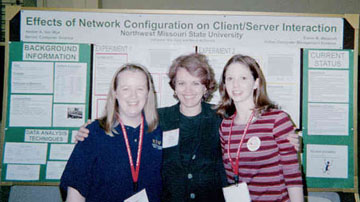
Clarke College Computer Science Department Chair Sheila Castaneda
(middle) visits with CREW students from Northwest Missouri State
University at the Association for Computing Machinery (ACM) Special
Interest Group on Computer Science Education conference in Austin,
Texas. Castaneda has served as CREW project leader for the past two
years.
Students from Lawrence University in Appleton, Wisconsin, created a Java-based system that allows instructors to easily administer exams over the Internet. Associate Professor of Mathematics Thomas Naps served as the advisor for Lerie Herrera, Pamela Kunes, and Laura Norton. "More than ten faculty members participated in our initial analysis and they are intrigued by the prototype that Lerie, Pamela, and Laura developed," Naps said. "The professors are anxious to use the final system, based on this prototype, in their courses next year."
Jennifer Wanner, Christy Lohrer, and Jen Levins from Xavier University (Cincinnati, Ohio) developed another system that will be utilized by their university. Wanner, Lohrer, and Levins developed a web interface that allows students to query particular subjects of university courses and receive a listing of open sections. "The students' work has already been presented as a poster at Xavier's Celebration of Student Research, and they also intend to present the work at the Consortium for Computing in Small Colleges: Midwest Conference at Valparaiso University in October," Assistant Professor of Mathematics and Computer Science Gary Lewandowski said.
"Comparison of Linear Programming, Genetic Algorithms and Constraint-based Search for the EYH Scheduling Problem" was an additional CREW project completed by Heather Simmons and Natalie Bickley of Texas Wesleyan University. Simmons and Bickley, who were advised by Assistant Professor of Computer Science Lisa Burnell, analyzed three methods for scheduling participants and speakers for a conference held annually at their university. The students both agreed that the experience of working as a team helped them learn how to support team members and was also beneficial in learning the discipline. "While doing this research project, we have been able to encourage each other to work harder and to not give up."
"Visualization of Persistent Data Structures" was a project completed by Risa Ohara and Oana Radulescu of Columbia University. Advised by Computer Science Professor Chris Okasaki, Ohara and Radulescu applied techniques of algorithm animation to persistent data structures. Meanwhile, "Intelligent Information Extraction" was explored by Elena Eneva and Katharina Probst from the University of the South in Sewanee, Tennessee; the students investigated text extraction and classification and the applicability of neural networks to the problem. Associate Professor of Mathematics Linda Lankewicz advised Eneva and Probst. Lankewicz said that both students benefited tremendously from the research experience and are now going on to graduate programs in computer science at Carnegie Mellon University this fall. "By reasoning critically and understanding and overcoming the challenges of the field, I gained valuable problem solving skills, experience, and confidence," Eneva said.
"CREW was a great learning experience for me," Probst said. "I gained insight into the process of researching a topic as well as producing a creative solution to a real-world problem. I learned to work more effectively in a team...and it also prepared me well for graduate research."
Proposals for 2000-01 CREW projects are currently being reviewed, and announcements regarding awards will be made later this month. Sheila Castaneda should be contacted at CREW@keller.clarke.edu for additional information.
CRA-W's mission is to take positive action to increase the number of women participating in Computer Science and Engineering research and education at all levels. In addition to mentoring programs and collaborative research projects, CRA-W activities include workshops and networking opportunities. CRA-W is funded by the National Science Foundation, including the Education, Outreach, and Training Partnership for Advanced Computational Infrastructure (EOT-PACI), which assists in travel to meetings and initial support for the committee's projects. More information about CRA-W can be found at http://www.cra.org/Activities/craw/. -KMB
© 2000 Online: News about the NPACI and SDSC Community